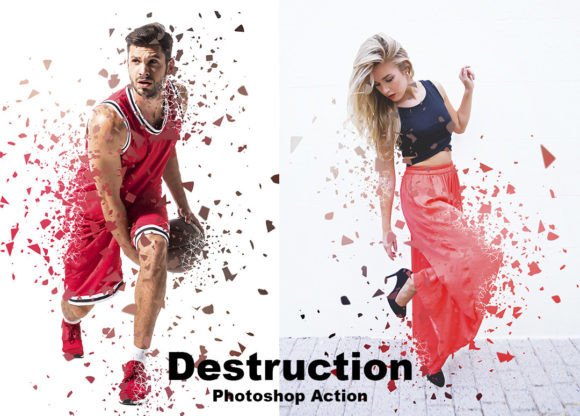
Destruction Photoshop Action: Transforming Images with Impact
In the realm of digital art and graphic design, the ability to manipulate reality is paramount. Whether you are creating a movie poster, designing an album cover, or crafting a surreal piece for social media, the visual impact often relies on the illusion of chaos, decay, or structural failure. This is where specialized tools become essential. The Destruction Photoshop Action stands out as a powerful resource for artists looking to add depth, texture, and narrative tension to their work without spending hours manually painting every crack and splinter.
For many designers, the challenge lies not in the concept but in the execution. Creating realistic destruction effects—shattered glass, crumbling concrete, or torn metal—requires a deep understanding of layer masking, blending modes, and texture manipulation. Doing this from scratch can be time-consuming and technically demanding. The goal is to achieve a professional, high-end look efficiently. The Destruction Photoshop Action addresses these needs by automating complex processes while retaining full creative control over the final outcome.
Understanding the Power of Non-Destructive Editing
One of the most significant advantages of using this specific tool is its commitment to non-destructive workflows. In professional design, "non-destructive" means that your original image remains untouched, allowing you to experiment freely without fear of permanent damage. The Destruction Photoshop Action operates entirely through adjustment layers, smart objects, and masks. This approach ensures that if a particular effect feels too intense or doesn't quite fit the mood, you can simply tweak the settings or turn off a specific layer group without having to start over.
This flexibility is crucial for iterative design. You might want to try a subtle weathering effect first, then ramp it up to total devastation later. Because the action keeps all elements separate and organized, you can isolate specific parts of the destruction. For instance, you could adjust the lighting on the debris independently from the cracks in the wall. This level of granularity transforms a simple script into a robust creative engine, empowering users to tailor the results precisely to their vision.
Streamlining Your Workflow with Organized Layers
A common frustration when using automated actions is the resulting mess of unorganized layers. Many free or low-quality scripts dump dozens of hidden layers onto your canvas, making further editing a nightmare. The Destruction Photoshop Action solves this problem by adhering to strict organizational standards. Every element generated by the action is placed within well-arranged folders, clearly labeled for easy navigation.
When you apply the action, you are greeted with a clean structure where each component of the destruction effect is adjustable. This includes shadows, highlights, textures, and color grading. If you need to change the color of the smoke or the opacity of the shattered fragments, you know exactly where to look. This thoughtful arrangement saves valuable time during the post-processing phase, allowing you to focus on creativity rather than housekeeping. It bridges the gap between automation and manual precision, offering the speed of a macro with the control of hand-crafted art.
Enhancing Realism with Custom Brushes
While the core action handles the heavy lifting of generating complex structures, true realism often comes down to the finer details. To support this, the package includes one dedicated ABR file brushes. These custom brushes are designed specifically to complement the destruction effects generated by the main action. They allow you to paint additional debris, dust particles, or specific texture overlays directly onto your composition.
The inclusion of these brushes expands the utility of the tool significantly. Perhaps the automated action creates a perfect crack pattern, but you need to add a few stray sparks or specific grime accumulation in a corner. With the provided brushes, you can seamlessly blend manual touch-ups with the automated effects. This hybrid approach ensures that no two images look identical, giving each project a unique fingerprint while maintaining a cohesive style.
Practical Applications and Creative Outcomes
The versatility of the Destruction Photoshop Action makes it suitable for a wide range of practical applications. In commercial advertising, brands often use destruction imagery to convey power, durability, or the breaking of barriers. A car advertisement might show a vehicle driving through a wall, or a tech product might be presented amidst a backdrop of shattered old technology. This action allows marketers to create these dramatic scenes quickly and cost-effectively.
In the entertainment industry, concept artists and illustrators use such tools to visualize scenes for films, video games, and comic books. Instead of modeling 3D environments from scratch, they can take a standard photograph of a building or landscape and apply the destruction action to instantly transform it into a war-torn zone or a disaster site. This accelerates the pre-production process, allowing teams to iterate on ideas rapidly.
Furthermore, photographers who specialize in surrealism or fine art can use the action to challenge perceptions. By applying realistic destruction to mundane subjects, they can create thought-provoking pieces that comment on fragility, entropy, or resilience. The key is that the tool serves as a foundation; the artist's intent dictates how far the transformation goes.
Technical Requirements and Best Practices
To get the most out of the Destruction Photoshop Action, it is important to understand its technical requirements and optimal usage conditions. The action is compatible with Adobe Photoshop versions CS4, CS5, CS6, and CC. However, it is critical to note that it works only for the English version of Photoshop. Users with localized versions of the software may encounter errors due to language-specific layer naming conventions used within the script.
Image resolution plays a pivotal role in the quality of the final output. For best results, it is highly recommended to use source images ranging from 1800 to 4000 pixels in width. High-resolution images ensure that the textures, cracks, and debris generated by the action remain crisp and detailed. Using lower-resolution images can result in pixelation or a loss of definition, diminishing the realism of the effect. Additionally, the action requires a single ATN file to run and utilizes the included ABR brushes for supplementary detailing.
Users should also be aware that the images shown in the preview gallery are for demonstration purposes only and are not included in the download. The action is a tool, not a collection of finished images. This distinction encourages users to bring their own photography or assets, fostering genuine creativity rather than reliance on pre-made templates.
Tailoring the Experience to Different Skill Levels
Whether you are a beginner or a seasoned professional, the Destruction Photoshop Action offers a scalable learning curve. Beginners will appreciate the "Easy To Use" nature of the script. With a single click, they can transform a boring photo into a dynamic scene, providing immediate gratification and a confidence boost. The clear documentation and help files included in the package guide new users through the installation and basic application process.
Advanced users, on the other hand, will find value in the adjustable layers. They can deconstruct the action to understand how the effects are built, then modify blending modes, opacities, and masks to create bespoke variations. This dual appeal ensures that the tool remains useful as your skills evolve. It acts as both a shortcut for quick projects and a sandbox for experimenting with advanced compositing techniques.
Conclusion
The Destruction Photoshop Action represents a significant step forward in digital asset management for creatives. By combining automation with non-destructive editing, organized layers, and custom brushes, it addresses the core challenges of time consumption and technical complexity. It empowers users to produce high-quality, impactful visuals that tell a story of conflict, change, or decay. Whether for commercial projects, artistic expression, or conceptual design, this tool provides the necessary foundation to turn ordinary images into extraordinary masterpieces. With proper attention to resolution and software compatibility, it becomes an indispensable part of any designer's toolkit.